
Drug and Alcohol Monitoring
U-VERIFY™ Testing vs Alcohol Breathalyzers

By Tim Reid · 2 min read

In family law cases where alcohol and/or substance use disorder is known or suspected to be involved, it is crucial for stakeholders to answer, “Does a parent’s (or parents’) alcohol and/or substance use affect child safety and parenting capacity?”
Family law courts generally view drug and alcohol testing as one piece of evidence alongside behavior, treatment participation, witness statements, and parenting history—not as a standalone determination of compliance.
When child custody and visitation matters are involved in divorce proceedings, drug and alcohol testing solutions should be:
Scientifically valid
Forensically/legally defensible
Random and difficult to predict
Test for a broad array of drugs and alcohol
Discreet and convenient
TESTING FREQUENCY BEST PRACTICES
For abstinence monitoring:
Alcohol Breathalyzer: Every 3-4 hours including throughout the nighttime.
U-VERIFY™ DNA-verified Drug and Alcohol Testing: 1x/weekly random testing.
Frequency can decrease over time with demonstrated stability and negative results.
For active impairment monitoring:
Alcohol Breathalyzer: Before and during parenting time or other desired periods.
U-VERIFY™ DNA-verified Drug and Alcohol Testing: does not test for impairment.
Urine drug and alcohol testing remains the most widely recommended specimen for abstinence monitoring because it balances cost, reliability, and comprehensiveness of test panel.
REMOTE TESTING OPTIONS
1. U-VERIFY™ DNA-verified Drug and Alcohol Testing
This is the most interesting model if you want to perform urine or blood based testing without sending the person to a collection site.
U-VERIFY™ uses an initial observed cheek swab to establish the individual's baseline DNA profile. Then remotely collected urine or blood samples are DNA-verified against that profile.
The big advantage is that you don't need somebody watching the person urinate every time.
For family law, that can be particularly useful when testing needs to occur frequently for months, rather than just once or twice.
2. Video-observed remote urine
This is another option, although the process is less straightforward and far more invasive.
The individual provides the specimen at home while a collector observes the process over video. Some services combine video observation with photo ID and other documentation.
Obvious privacy concerns
Not trauma-informed.
3. Remote oral-fluid testing
This is probably the easiest fully remote approach operationally.
The person receives an oral-fluid device and completes the collection while being monitored remotely.
It can test for multiple drugs, although less than urine.
The trade-off is the shorter detection window compared with urine.
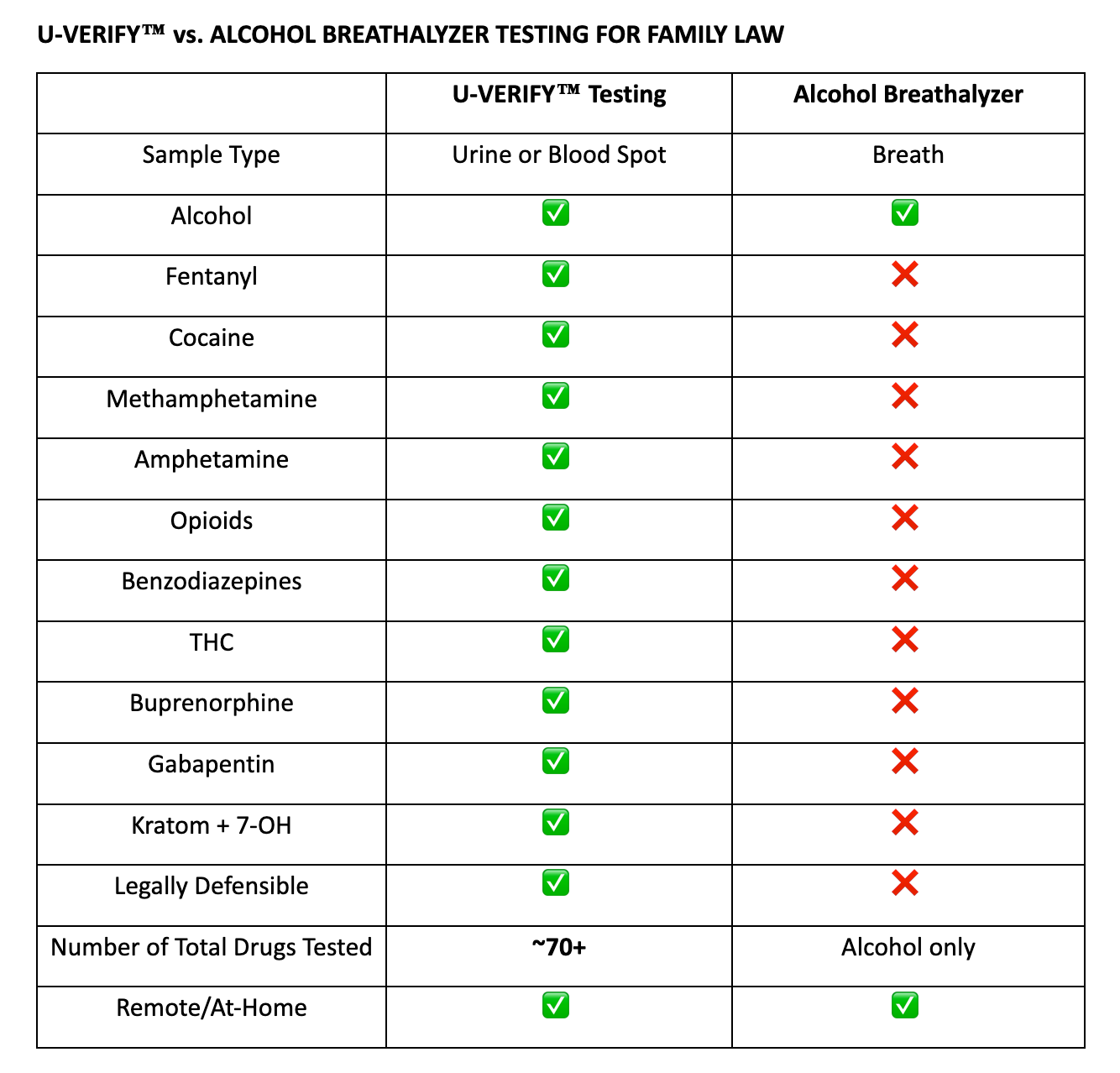
When Family Law professionals need more than alcohol monitoring, U-VERIFY™ Testing is unmatched. U-VERIFY™ Testing has a much broader test panel, legal defensibility, and dignified sample collection.
About the contributor

Executive Director – U-VERIFY™ Testing
Get help
Ready to speak with a divorce lawyer?
Connect with experienced divorce attorneys in your area.
Find a lawyerExplore our full article library